My next project is a book of photos of animal remains accompanied by stories and reporting.
Here are some samples. Please be mindful of the reality of animal death; some might find the images below upsetting.
Caught
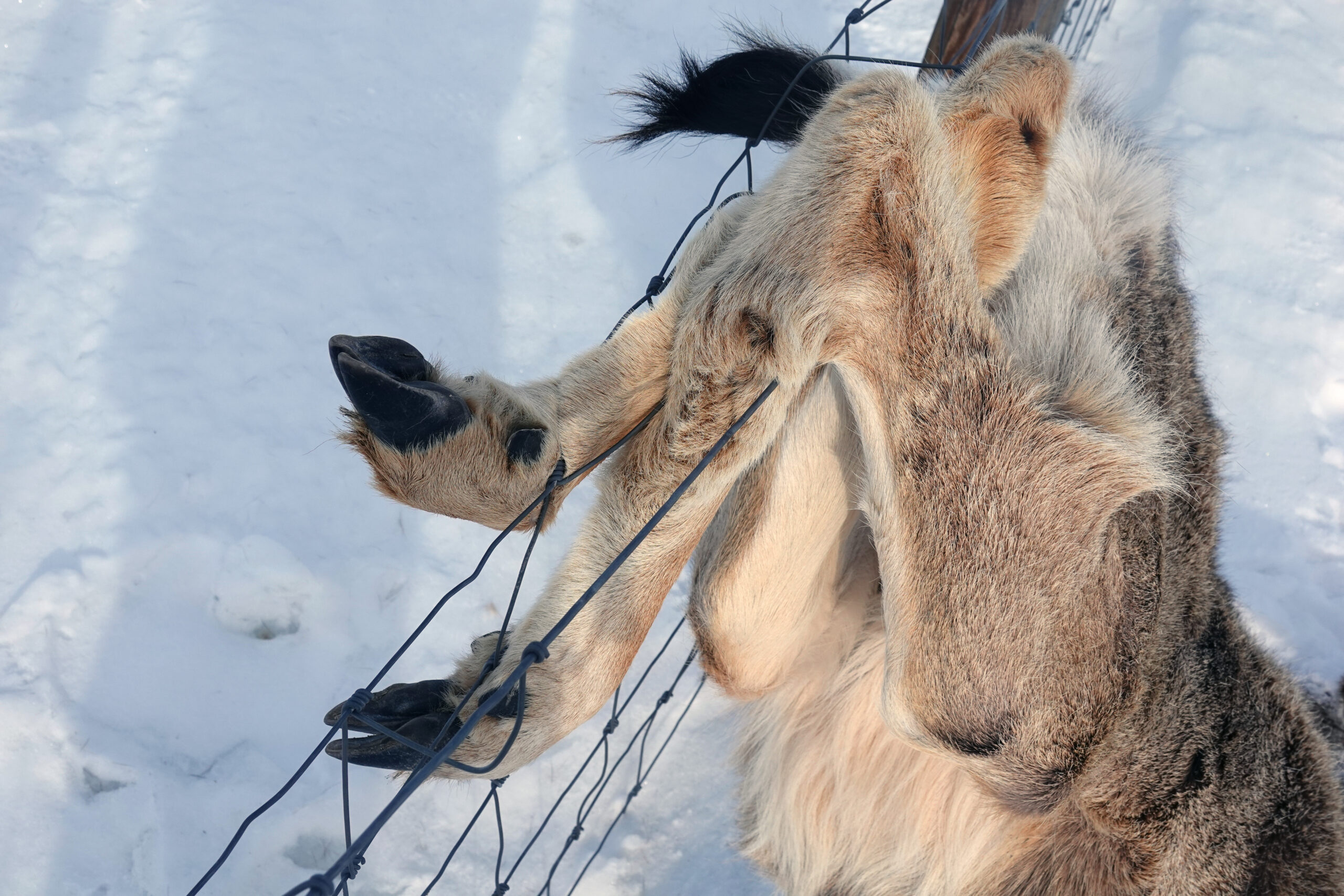
I knew this deer was beyond rescue as soon as I saw him caught in the fence. Death is an unmistakable calmness. A creature immobilized forever is a sad sight, but his stillness sure made it easy for me to take pictures. As I walked around him, a story unfolded.
First, the only blood I saw in the snow was around where his antlers would have been, suggesting that someone had come along and sawed them off. Second, there were coyote tracks leading from another deer carcass, about four or five meters away, to him, but he was intact and unbitten. Third, about ten meters away, there was a mound of dirt with deer hoofprints in it, a gap in the fence, and a trail cam – indicating that someone had set up a safe way for him and his kin to cross. A wildlife crossing. I guess he didn’t see it.
Golden
If you look around while on this road, you will find roadkill.
In fact, you will probably find roadkill even if you don’t.
I stepped out of the car a dozen or so times. And every time, I found the remains of a dead deer or elk.
While bones have a way of merging into the landscape, requiring a trained eye, fresh carcasses can’t be avoided. They are stinky, they are bold, they are red with blood.
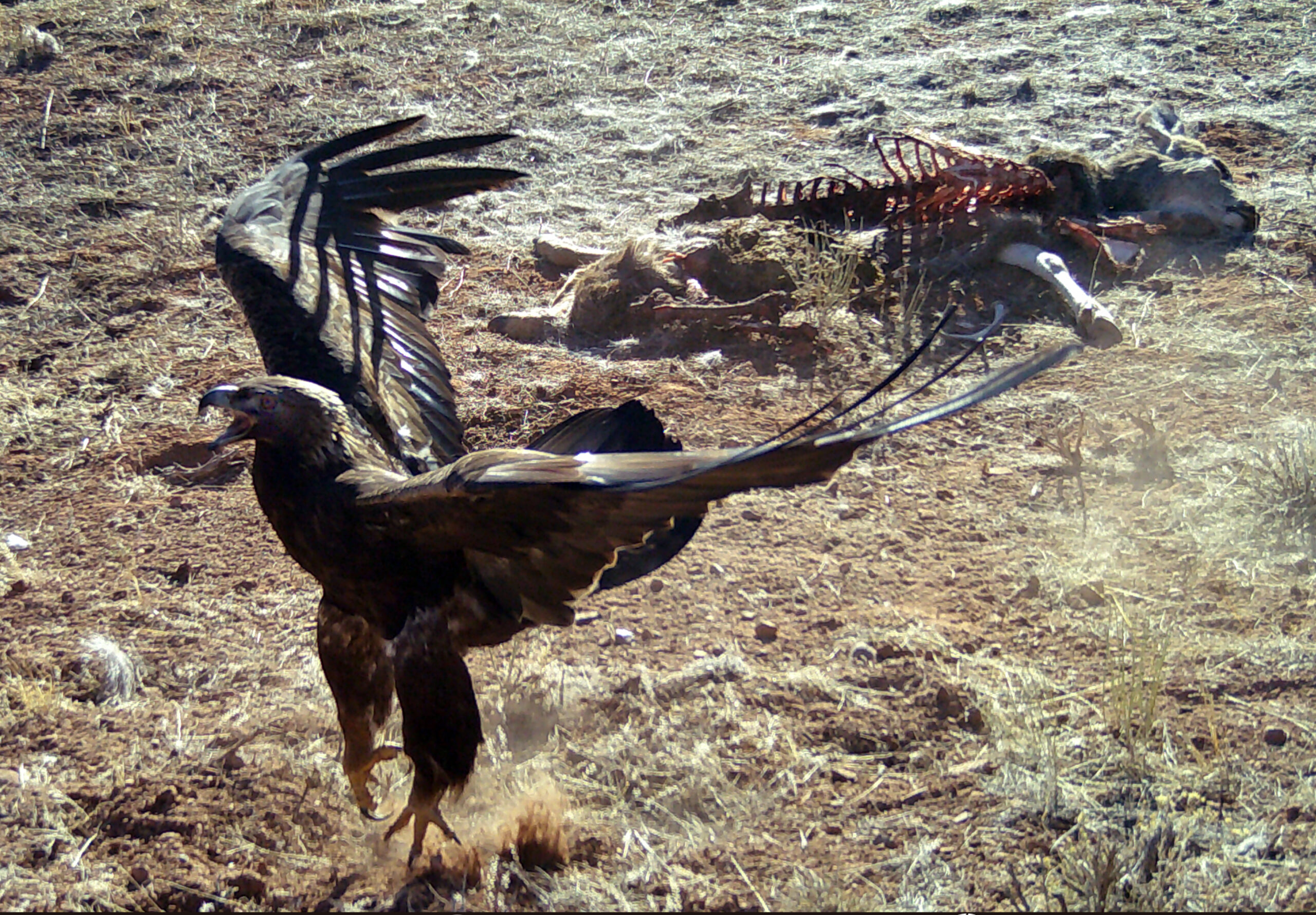
I set a trail cam on this one; the results included coyotes, magpies, and vultures eating this carcass. My favorite was this golden eagle, who consistently stopped to scare away the magpies.
Hung
I’m not scared of humans. But I have a healthy caution around certain animals, and I’ve never met an intact male goat I felt safe around.
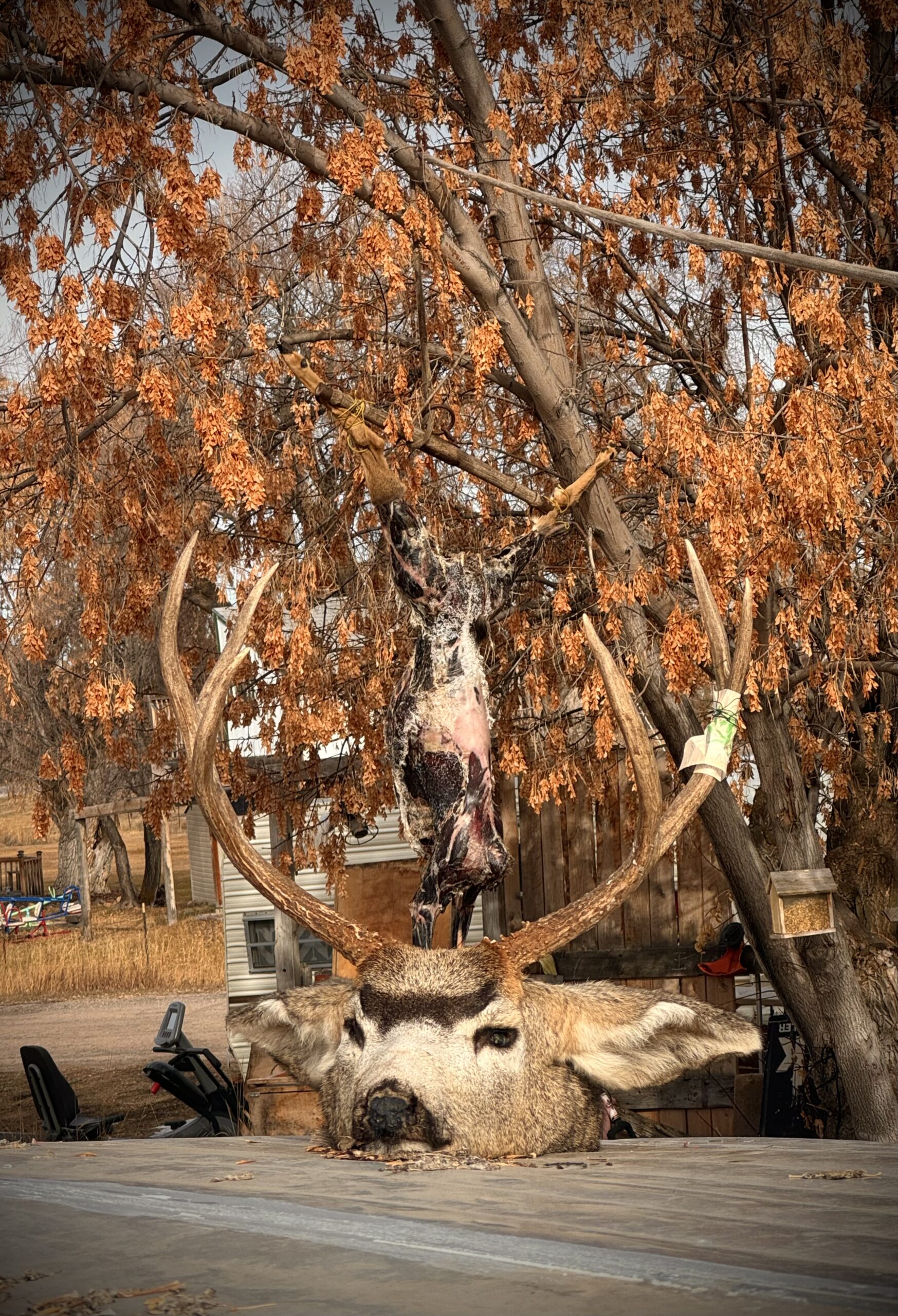
There was an intact male goat with short legs and long horns surrounding this property, so I drove around until he had left my direct access point. I knew I could legally take a photo of this deer from the road, which is part of the reason I was shocked to see it from there. In a tourist town, no less!
In photography and journalism, there is the concept of a “reasonable expectation of privacy.” This carcass, hung in the front yard with the severed head resting on an old trailer, had none.
But, as a courtesy, I like to ask people to photograph their properties. Sometimes they have a social media account to tag, and they often offer me more to photograph, or recommend something nearby. Best of all, they often tell me stories, so I get to learn the context of these animal remains.
I parked and approached the front door cautiously. Yes, it is legal to walk on someone else’s land without permission in many contexts, such as in pursuit of ringing their doorbell. That’s why doorbells exist.
Before I could reach the door, it opened, and out stepped a woman carrying a long-muzzled gun pointed down.
I hadn’t done anything wrong, and I knew she had no right to shoot me. If she was willing to commit murder against anyone who would walk up to her door, she would have killed a delivery person by now and been jailed. So, despite facing a stranger with a gun, I proceeded to ask if I could photograph the deer hanging in her yard.
She grinned. She was excited. She wanted to know more about my photo project, and she enthusiastically approved. She even told me there was a moose head nearby I should photograph.
The gun went unmentioned until it didn’t. She was the one who brought it up:
“Oh, this looks weird,” she said, keeping the muzzle down. “I wasn’t going to shoot you. This is a BB gun. I carry it when I go outside to scare that damned goat away.”
Touch
I’ve visited four slaughterhouses, always curious about what people do the same and what they do differently.
I have lots of gorey photos from them, as “animal” becomes “meat.” I have videos of severed body parts still twitching. Hung pigs bleeding out from their necks, a strange machine pulling skin from a body. They are all fascinating looks inside the (almost literally) sausage factory.
This slaughterhouse was the most transparent. There was even a phone on a tripod in the corner. “We livestream every slaughter,” said the owner of the facility, Aims Brunkow.
This bovine entered the squeeze shoot, and the slaughterman pulled a lever to keep her more steady.
“You can photograph everything but the knock,” Brunkow said. I was disappointed for a moment; I wanted to get everything. Was the “knock” so upsetting they really needed to keep it secret.
“It’s because we don’t want the light or sound to distract the cow.”
That made perfect sense: if you surprise or distract the cow, she might move to look, and then the bullet would go in the wrong place, hurting her unnecessarily. It’s critical that she kept still so that the shot, meant to render them insensible to pain or kill them, was in the correct spot in her forehead.
I sighed in relief. That’s all?
When I was setting up my camera, I chose to make it silent, imagining myself in a remote, desolate landscape with stealthy animals eager to avoid humans. The silent camera led to unending frustrations, as I was often unsure whether it had fired at all; perhaps I had a wrong setting on, or a timer, or some other issue that would prevent the camera from registering what was in front of it, despite my insistent pressing of the shutter.
But, finally, the silence came in handy.
“This camera doesn’t make any noise or have a flash on,” I insisted.
Brunkow checked with the slaughterman, who allowed it as long as it was certain the camera would not disturb the cow.
I was curious whether there would be much to photograph during the “knock.” I knew that blood wouldn’t spurt out or anything like that, but capturing the moment of death seemed visceral, significant, and extremely rare.
I did shoot the moment of death, some before, and many after.
However, this was the scene that I kept coming back to. Just before the slaughterman lowered the gun, he reached out and touched the cow on the nose. He did this for every cow I saw.
Perhaps he was simply trying to get the cow to look in the right direction to be killed.
But, the slow, tender, silent moment had me believing in my heart that it was something much more than that.
The Sacrifice of the Bighorns
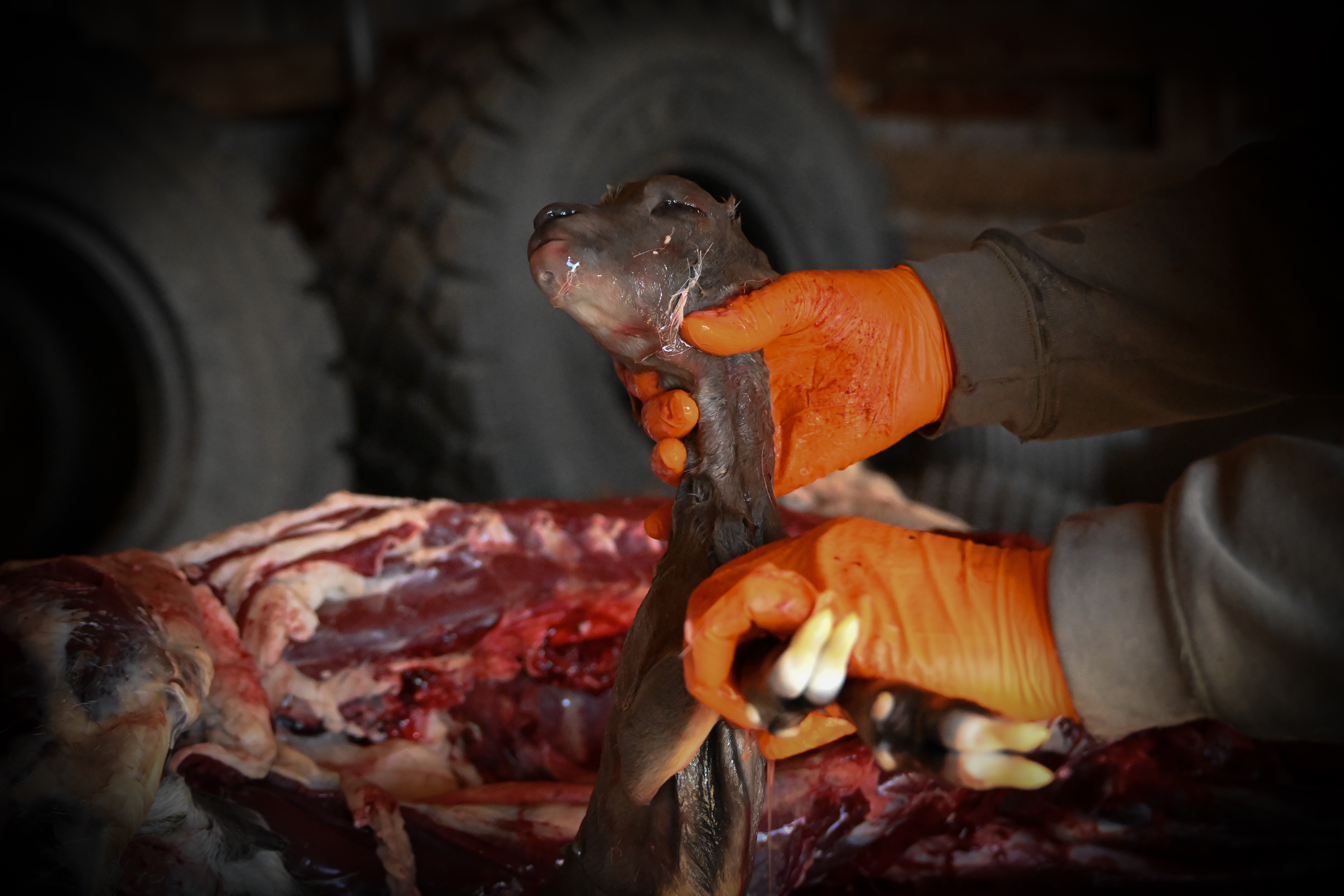
When I was Artist In Residence at Badlands National Park, I asked everyone to let me see things related to animal remains. One day, I got a call about a necropsy, and I rushed to see park staff study and process a pregnant bighorn sheep that they had killed due to her contagious illness.
You can see more of my writing and photographs about the program and the resulting carcasses here.
